
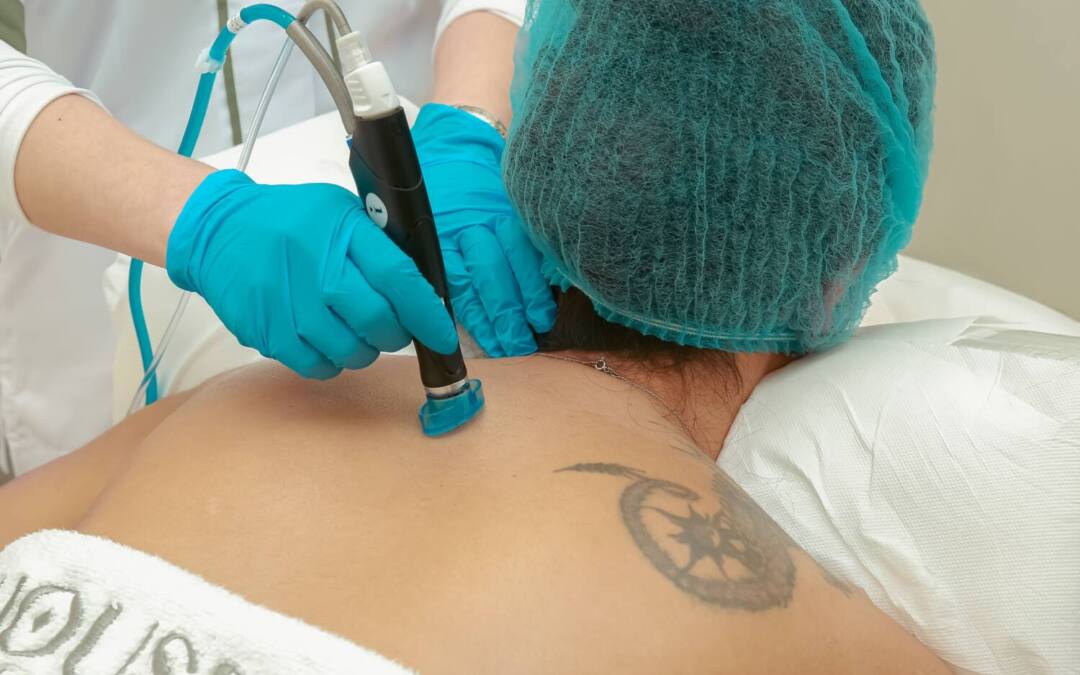
Most people who sit down with me about a tattoo assume the laser is going to burn the ink out of the skin. It isn’t, and that’s the first thing I explain. The laser breaks the ink into particles so small that your own immune system can carry them off, and it does that with pulses of light so short that the skin around the ink barely warms. The vascular laser I use for broken capillaries and cherry angiomas works on the same principle with a different target: a wavelength that blood absorbs, held on a visible vessel just long enough for it to close and fade. Almost everything else about how these two lasers behave, from the number of sessions to who they suit, comes back to the length of that pulse.
Laser tattoo removal at a glance
- Target: tattoo ink in the dermis, the layer under the surface of the skin
- Lasers used at LuXe: a Q-switched Nd:YAG laser at 1064 and 532 nm, and a picosecond laser
- Pulse length: billionths of a second (Q-switched) or trillionths of a second (picosecond)
- Sessions: from six to more than ten for a tattoo, spaced six to eight weeks apart
- What responds best: black and dark ink; white, pink, red, tan, and light brown pigments can darken instead of clearing
- Vascular laser: a long pulse Nd:YAG laser for small facial vessels, cherry angiomas, and small spider veins, often one or two sessions
- Performed by: Deborah Lenchus, MSN, APRN, at 11336 West State Road 84, Ste 7 & 9, Davie
What a laser does to tattoo ink
Laser tattoo removal works by selective absorption: the laser emits a wavelength of light that the ink absorbs far more strongly than the surrounding skin does. When a very short pulse of that light hits an ink particle, the particle heats and expands faster than it can pass the heat to its surroundings, and it shatters. The fragments are small enough for the immune system to clear, which it does slowly over the weeks after each session. That’s why a tattoo fades between visits rather than during them.
Lasers have largely replaced the other methods of removing a tattoo, because the ink sits in the dermis, below the layer of skin that renews itself, and a laser reaches it without opening the skin. The light passes through the surface, and because the pulse is so brief, the skin around each particle is spared most of the heat. The white frosting you may see on the tattoo immediately after a pass is normal and fades within minutes.
Q-switched or picosecond: what the pulse length changes
The two lasers that remove tattoos differ mainly in how short the pulse is. A Q-switched laser stores energy inside the laser and releases it in a burst measured in nanoseconds, billionths of a second. A picosecond laser releases its burst in trillionths of a second, about a thousand times faster. The American Society for Laser Medicine and Surgery describes Q-switched and picosecond lasers as the most effective methods of tattoo removal and notes that picosecond lasers are better at shattering ink particles, which matters most for stubborn colors. At LuXe, Deborah Lenchus works with both: a Q-switched Nd:YAG laser for tattoo removal in Davie, and a picosecond laser for pigment and tattoo work. Which one she reaches for depends on the ink, the skin, and how the tattoo has responded so far.
Shorter isn’t always the whole story. A picosecond pulse breaks ink into finer fragments, but the body still has to clear them, and the six to eight weeks between sessions is set by that clearance, not by the laser. No tattoo comes off in one visit with either technology.
Why ink color and skin tone decide the wavelength
The wavelength is chosen for the color of the ink, because each color absorbs some wavelengths and reflects others. Black absorbs every laser wavelength, which is why black ink is the easiest to remove. The 1064 nm wavelength is used for black, blue, and other dark inks, and the 532 nm wavelength for red, orange, and some lighter colors. Green and sky blue are more selective about the light they absorb, so they take longer and may need a different wavelength than the one that cleared the black outline beside them.
Some pigments should not be lasered at all. White, pink, red, tan, and light brown inks, the colors common in cosmetic tattooing, can oxidize and turn darker under a laser, and once that happens the pigment no longer responds to laser treatment. Deborah checks for these colors at the consultation and will tell you if a tattoo, or part of one, is better left alone or treated a different way.
Skin tone sets the wavelength as much as ink color does. Melanin in the skin absorbs laser light too, so a wavelength that targets ink can also heat the surrounding pigment in darker skin. Longer wavelengths pass deeper and interact with skin pigment less, which is why 1064 nm is the wavelength chosen for darker skin tones and why the 532 nm wavelength is reserved for lighter skin. Deborah assesses your skin type before any laser treatment and sets the energy for it; the same tattoo on two people may need two different plans.
What the official record says about these lasers
Lasers in this class are FDA cleared for the removal of dark ink tattoos at 1064 nm and light ink tattoos at 532 nm, for the removal of benign pigmented lesions, and, in the long pulse form, for the coagulation of benign vascular lesions such as telangiectasia, rosacea, venous lakes, leg veins, and spider veins. Picosecond lasers carry tattoo removal clearances of the same kind, with the 1064 nm wavelength covering all skin types and the 532 nm wavelength limited to lighter skin. The clearances describe what the devices may be marketed for; how a given tattoo or vessel is treated, and whether it should be, is a clinical judgment made at your consultation.
How many sessions laser tattoo removal takes
Most tattoos need somewhere between six and more than ten sessions, spaced six to eight weeks apart, and the number depends more on the ink than on the laser. A professional tattoo with dense, layered, multicolored ink sits at the top of that range; a small, old, black tattoo often sits near the bottom. The interval isn’t a waiting period for its own sake. The body needs those weeks to absorb the fragmented pigment, and treating sooner doesn’t speed it up.
A laser cannot safely break down every layer of ink in one session, which is why the number is never one. Each session lightens the tattoo further, and some tattoos never clear completely: a faint shadow or a ghost of the outline can remain even after a full series. Deborah will tell you at the consultation whether your tattoo looks like one that clears or one that fades, and the plan is revisited as the ink responds.
What a vascular laser does
A vascular laser closes small, visible blood vessels by heating the blood inside them. The laser is set to a wavelength that hemoglobin, the red pigment in blood, absorbs more than the skin around it, and the pulse is long enough to warm the whole vessel rather than shatter a particle. The warmed vessel collapses and seals, and over the following days and weeks the body absorbs it, so the red line or spot fades. The vascular laser at LuXe is a long pulse Nd:YAG laser, which uses the same 1064 nm wavelength as the tattoo laser in a far longer pulse.
The vessels it treats are the ones you can see. Telangiectasias, which most people call broken capillaries, are small, widened blood vessels on the skin; they are dilated rather than broken, and sun exposure and aging are two of the common causes on the face. Cherry angiomas are benign skin growths made up of blood vessels, the small bright red dots that become more common after age 30. Small spider veins on the legs are the same kind of target, though larger or deeper leg veins need a different approach. The laser is also used for the visible vessels and flushing that come with persistent facial redness; where that redness is rosacea, the diagnosis belongs to a clinician, and the laser treats the vessels, not the condition.
The number of sessions is usually small. The American Society for Laser Medicine and Surgery says vascular lesions may disappear entirely after one or two treatments or may require a series, and at LuXe cherry angiomas and isolated vessels often respond in one or two visits while diffuse redness improves over a short series. A treated spot may darken or turn grayish right after treatment, which is the sign the vessel has been targeted, and it clears over the following days.
Why the same wavelength does two different jobs
The 1064 nm wavelength appears in both halves of this article because the pulse length is chosen for the target. Tattoo ink is a solid particle that has to be shattered, so the pulse is as short as the laser can make it and the energy arrives before the heat can spread. A vessel is a tube of liquid that has to be warmed through, so the pulse is stretched out and the heat is the point. One wavelength, two pulse lengths, two different treatments, and the reason a Q-switched laser is kept for ink and a long pulse laser for vessels.
What a session at LuXe is like
- Deborah reviews your health history, your medications, and any recent sun or self tanner, and examines the tattoo or the vessels; for a tattoo she notes the colors and the depth of the ink.
- The area is cleansed. For a tattoo, numbing cream is usually applied first; for a vascular treatment, cooling is used during the pass.
- You wear eye protection, and so does she, for the whole treatment.
- The laser is passed over the area. For a tattoo, most people describe the feeling as a rubber band snap or hot pinpricks, and the ink frosts white for a few minutes. For a vessel, most people feel a quick, warm snap.
- A small tattoo or a few vessels take minutes; a large or dense tattoo takes longer. You leave with written aftercare and the date of your next session.
Risks, side effects, and when to call
After laser tattoo removal, expect redness, swelling, and sometimes a little blistering, and pinpoint bleeding and crusting are common. The serious risks are skin discoloration, infection, incomplete removal of the pigment, and scarring; the American Society for Dermatologic Surgery notes that a raised or thickened scar may appear three to six months after a tattoo is removed, and the risk of scarring is always present, sometimes already there from the tattooing and hidden by the ink. Some people develop light or dark spots in the treated skin, which tend to disappear within six to twelve months, though laser removal can leave skin lighter than the skin around it. Darker skin is more prone to burns and dark marks after laser treatment, which is the reason for the wavelength and energy choices above.
The FDA’s own patient page on tattoo removal lists possible scarring, infection, pinpoint bleeding, redness, and soreness among the risks of laser removal and says that complete removal can take many treatments and in some cases may not be possible. After a vascular treatment, most people need no downtime, though there may be some bruising for a few days, and the treated spot can darken briefly before it clears; pigment change and a small blister or mark are the less common effects.
Call the practice right away at (754) 715-5667 if you have intense pain or any effect you did not expect after a treatment, and the same day if a blistered area looks infected. Treatment is deferred during pregnancy, over an active infection or open skin at the site, on recently tanned skin, and while you are taking a medication that increases light sensitivity; recent isotretinoin use is reviewed before any laser treatment.
Aftercare
For a tattoo, keep the area clean and moist and covered until the skin heals: an ointment and a dressing for the first days, then moisturizer, and a shower the next day is fine as long as you don’t scrub the spot. Don’t pick at crusts or blisters. Protect the treated skin from the sun for three months, with clothing that covers it, and once it has healed use a broad spectrum SPF 30 or higher sunscreen every day. For a vessel, avoid sun and heat for a few days, use sunscreen, and let any treated spot clear on its own. Deborah gives written instructions at each session, and those instructions take precedence over anything general here.
What these lasers do not do
A tattoo laser doesn’t guarantee a blank patch of skin. Some tattoos lighten rather than vanish, cosmetic inks can darken, and a scar left by the tattoo needle stays after the ink is gone. A vascular laser clears the vessels you have now; it doesn’t stop new ones from forming, and where the redness is rosacea the laser treats the vessels and leaves the condition to be managed over time. Neither laser resurfaces the skin, so wrinkles, acne scars, and texture are the work of the fractional resurfacing lasers, and diffuse sun damage across the face is usually a job for intense pulsed light rather than a single wavelength. Large or deep leg veins are outside what a surface laser treats and are referred on.
Frequently asked questions
Does laser tattoo removal hurt?
It is uncomfortable, and most people compare it to a rubber band snapping against the skin or hot pinpricks. Numbing cream is applied before a tattoo session at LuXe, and a small tattoo is treated in minutes, which is less time than it took to get it.
Can a tattoo be removed completely?
Often, but not always. Black ink on lighter skin clears most reliably; multicolored, dense, or cosmetic ink may fade without vanishing, and some tattoos never fully resolve. Deborah gives you her read on your tattoo at the consultation, and the plan is adjusted as the ink responds.
Is a picosecond laser better than a Q-switched laser?
A picosecond pulse shatters ink into finer fragments and handles stubborn colors better, which is why both lasers are in use at LuXe. It doesn’t shorten the weeks between sessions, because those are set by how fast your body clears the fragments.
What is a vascular laser used for?
A vascular laser treats small visible blood vessels: telangiectasias on the face, cherry angiomas, small spider veins, and the vessels behind persistent facial redness. It works by warming and sealing the vessel so the body absorbs it.
Does laser tattoo removal work on darker skin?
Yes, with the right wavelength and energy. Darker skin is treated with the longer 1064 nm wavelength, which interacts less with the skin’s own pigment, and at lower energy, and it carries a higher risk of dark marks and burns, so the plan is set for your skin type before the first pulse.
How long after a session can I go in the sun?
Keep a treated tattoo out of the sun for three months, covered by clothing, and use SPF 30 or higher daily once it has healed. Sun before a session matters too: a tan raises the risk of pigment change, so you come to each visit untanned.
Keep reading
- Laser tattoo removal in Davie, the treatment page
- Vascular laser for facial veins and cherry angiomas
- Pico laser treatment for pigment and tattoos
- Rosacea and facial redness treatment
- Fractional laser skin resurfacing
- IPL photofacial
- What IPL treatment is, and why an IPL photofacial is not a laser
- What a radiofrequency skin treatment is
- Laser hair reduction explained
Sources
- American Society for Laser Medicine and Surgery. Tattoo Removal. https://www.aslms.org/for-the-public/treatments-using-lasers-and-energy-based-devices/tattoo-removal. Updated 07/18/2022.
- American Academy of Dermatology. Tattoo removal: Lasers outshine other methods. https://www.aad.org/public/cosmetic/hair-removal/laser-tattoo-removal. Last updated 11/28/2023.
- American Society for Dermatologic Surgery. Laser Therapy for Unwanted Tattoo. https://www.asds.net/skin-experts/skin-treatments/laser-light-therapy/laser-therapy-for-unwanted-tattoo. Accessed 11/10/2026 (page undated).
- U.S. Food and Drug Administration. Tattoo Removal: Options and Results. https://www.fda.gov/consumers/consumer-updates/tattoo-removal-options-and-results. Content current as of 08/03/2023.
- American Society for Laser Medicine and Surgery. Vascular and Pigmented Lesions. https://www.aslms.org/for-the-public/treatments-using-lasers-and-energy-based-devices/vascular. Accessed 11/10/2026.
- American Academy of Dermatology. Skin conditions that lasers can treat. https://www.aad.org/public/diseases/a-z/skin-conditions-lasers-treat. Last updated 08/31/2021.
- U.S. Food and Drug Administration. 510(k) Summary K240983, Discovery Pico (Quanta System). https://www.accessdata.fda.gov/cdrh_docs/pdf24/K240983.pdf. Decision 06/06/2025.
- U.S. Food and Drug Administration. 510(k) Summary K240396, Elite iQ PRO (Cynosure). https://www.accessdata.fda.gov/cdrh_docs/pdf24/K240396.pdf. Decision 03/08/2024.
- MedlinePlus. Telangiectasia. https://medlineplus.gov/ency/article/003284.htm. Reviewed 06/03/2025.
- MedlinePlus. Cherry angioma. https://medlineplus.gov/ency/article/001441.htm. Reviewed 10/14/2024.
Book a consultation
Every laser plan at LuXe starts with a consultation with Deborah Lenchus, MSN, APRN, who examines the tattoo or the vessels, assesses your skin type, and tells you what to expect before the first pulse. The consultation carries a fee, which is applied toward any treatment or product you choose. Book online or call (754) 715-5667. LuXe Concierge Aesthetics, 11336 West State Road 84, Ste 7 & 9, Davie, FL 33325; Monday to Friday 9:00 am to 6:30 pm. Patients come from Weston, Cooper City, Fort Lauderdale, and across west Broward County.