Fractional Laser Skin Resurfacing
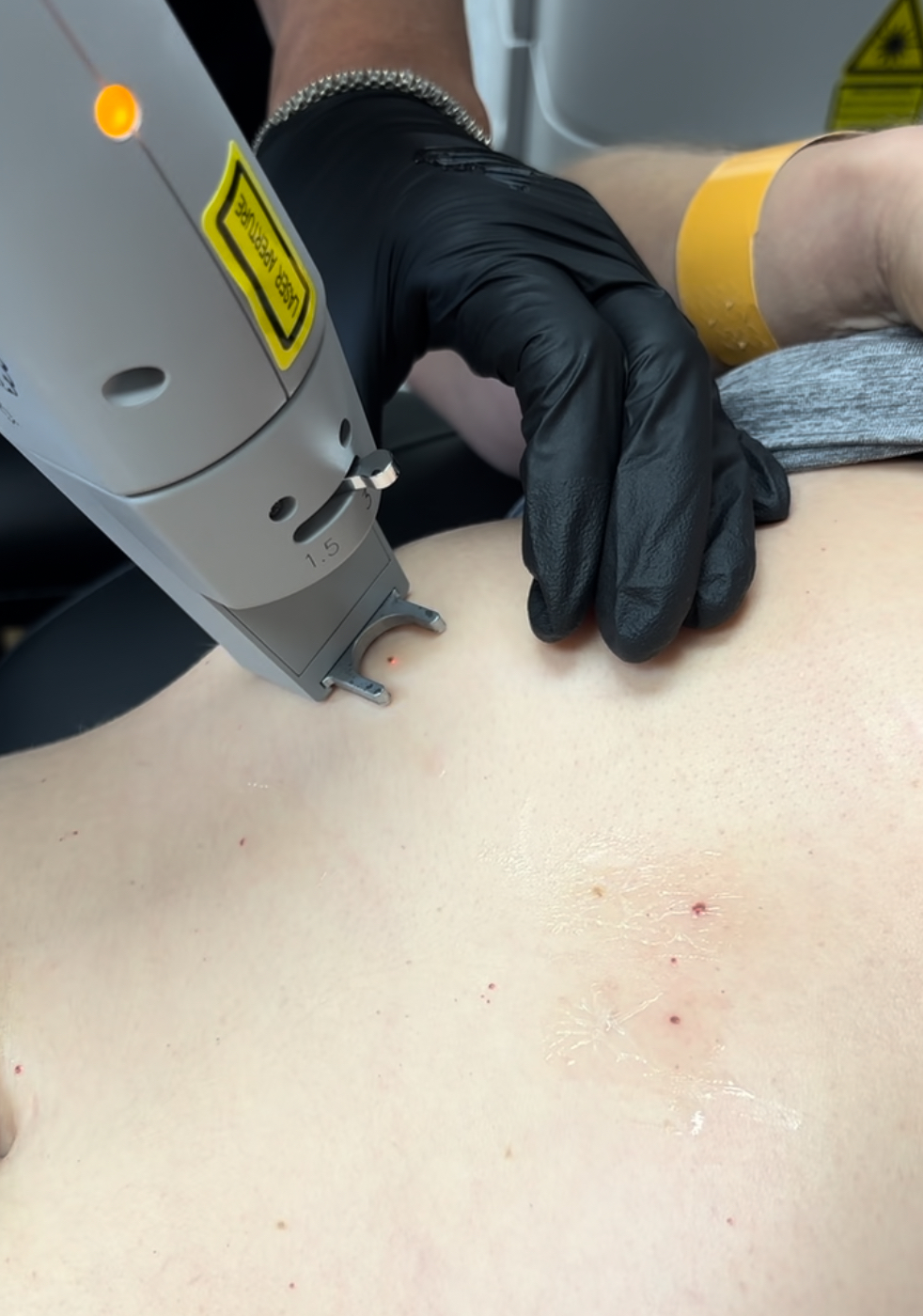
Fractional laser skin resurfacing treats the skin in a grid of microscopic columns and leaves the skin between the columns untouched, so the treated area heals from the healthy tissue around each column. It is used for the appearance of fine lines and wrinkles, sun damage, uneven texture, enlarged pores, and acne scars. At LuXe Concierge Aesthetics, nurse practitioner Deborah Lenchus performs every resurfacing treatment herself and chooses among three wavelengths according to your skin, your concern, and the recovery you can plan for.
The essentials
- Fractional is a pattern of treatment, not a type of laser. Any resurfacing laser can be run fractionally.
- Ablative resurfacing removes the surface layer. It produces the greater change and the longer recovery.
- Non ablative resurfacing heats beneath the surface and leaves it intact. It is done as a series, with a few days of pinkness after each session.
- Wavelengths used here: 10,600 nm carbon dioxide (ablative), 2,940 nm erbium YAG (ablative), and 1540 nm erbium glass (non ablative).
- Healing after ablative resurfacing: three to ten days of visible healing depending on depth and laser, then pinkness that fades over the following weeks.
- Who performs it: Deborah Lenchus, the nurse practitioner who owns the practice, in person, every session.
- Where: the Davie office, for patients from Weston, Fort Lauderdale, Cooper City, and across west Broward County.
Laser Treatments
- Pico Laser — pigment, melasma & tattoo removal (new)
- Erbium Glass 1540 — non-ablative resurfacing (new)
- Laser Hair Removal — tri-wavelength 755 / 810 / 1064 nm diode
- IPL Photofacial — sun damage, redness & rosacea
- Q-Switch YAG — tattoo & pigment removal
- Erbium YAG Skin Resurfacing
- Fractional CO2 Resurfacing
- Long-Pulse YAG — vascular & facial veins
What “fractional” means
A fractional laser divides its beam into thousands of fine columns. Each column treats a microscopic zone of skin, and the skin around it is left intact. Those bridges of untreated tissue are what let the area recover far faster than a treatment that removes the whole surface at once.
Fractional describes how the energy is delivered. The laser itself is defined by its wavelength, and a carbon dioxide laser, an erbium YAG laser, and a 1540 nm laser can each be run fractionally. The two ablative lasers here can also be run as a full pass over the whole surface when a more complete resurfacing is the right call.
Depth is a setting. The density of the columns and the energy in each are adjusted to your skin and your goal, which is why two people treated with the same laser can have quite different recoveries.
Ablative or non ablative: the difference that sets your recovery
Ablative lasers vaporize the outer layers of the skin. That removal is what produces the more substantial change in deeper wrinkles and textured scarring, and it is also what produces the downtime, because the surface has to grow back. The American Society for Laser Medicine and Surgery describes ablative lasers as capable of significant improvement in wrinkles, with a few weeks of downtime.
Non ablative lasers heat the deeper skin and leave the surface in place. The heat stimulates new collagen over the following months and improves texture and tone, with less downtime, usually across a series of sessions.
Neither approach is better in general. The ablative lasers do more in one visit and ask more of your calendar; the non ablative laser works gradually and lets you return to your week the next day. Which suits you is decided at the consultation, from your skin type, the concern, and how much visible healing you can plan for.
The three resurfacing wavelengths at LuXe Concierge Aesthetics
Each laser is defined by its wavelength, and the wavelength decides how the energy behaves in skin. All three below are absorbed by water in the tissue; they differ in how strongly, and that difference sets depth, heat, and recovery.
Fractional CO2 laser, 10,600 nm
The carbon dioxide laser is the deepest of the three. It is ablative, it leaves more heat in the surrounding tissue, and that heat is part of why it produces the greatest change in deeper wrinkles, acne scars, and heavy sun damage on the face, neck, chest, and hands. Expect about a week of visible healing followed by pinkness that fades over the following weeks. Read about fractional CO2 laser resurfacing.
Erbium YAG laser, 2,940 nm
Erbium YAG is also ablative, and its wavelength is absorbed by water far more strongly than the carbon dioxide laser’s. It removes very thin layers precisely, with little heat spreading beyond them, so recovery is shorter and the treatment suits finer lines, texture, tone, and thinner or more delicate skin. It can be run fractionally or as a full pass. Read about erbium YAG skin resurfacing.
Erbium glass laser, 1540 nm
The 1540 nm laser is non ablative. It heats fine columns in the deeper skin and leaves the surface intact, so most people are pink and slightly rough for a few days rather than at home for a week. It is used as a series for texture, pores, fine lines, and acne scars, and because it does not target pigment it is the resurfacing laser considered first for deeper skin tones. Read about erbium glass 1540 nm resurfacing.
How a resurfacing treatment works, step by step
- Consultation. Your skin type, history, medications, and goals are reviewed, and your skin is mapped with a 3D imaging scan. This is where the laser, the depth, and the number of sessions are chosen, and where you will hear a no if resurfacing is not the right tool for the concern.
- Preparation. Depending on the laser and the depth, you may be asked to stay out of the sun for several weeks, pause certain active skincare, and, if you have a history of cold sores, take an antiviral first. Numbing is applied in the office, and your eyes are shielded for every pass.
- Treatment. The laser passes over the area in a controlled pattern. An ablative pass feels like heat; the non ablative laser feels like prickly warmth under the numbing. A full face typically takes under an hour of treatment time.
- Healing. The surface heals first, over days. New collagen forms over the following months, which is why the result keeps improving long after the skin looks settled. Written aftercare comes home with you, and the practice is reachable throughout your healing.
What to expect while you heal
After ablative resurfacing, the American Society for Dermatologic Surgery describes swelling for 24 to 48 hours, itching or stinging for 12 to 72 hours, and the old skin peeling away about five to seven days after treatment. Healing takes three to ten days depending on depth and laser, deeper treatments can take longer, and pinkness after that can last several weeks. After a non ablative session, redness and swelling settle over the first day or two, the skin feels like fine sandpaper for a few days as it flakes, and most people look like themselves again within about a week.
Risks. Every resurfacing laser carries risks, and the deeper the treatment, the more they matter: prolonged redness, swelling, burns, blistering, crusting, infection, reactivation of cold sores, changes in pigment (darkening or lightening), and scarring. Darker skin is more prone to burns and dark marks after laser treatments, which is why skin type governs the choice of laser and settings here. Eye protection is worn throughout every treatment.
When to call. Call the practice the same day for intense pain, spreading redness, blistering, any sign of infection, any area that begins to darken, or any change in your vision after a treatment near the eyes. Do not wait to see whether it passes.
Aftercare, in brief. Gentle cleansing, an occlusive ointment until the surface has healed, no picking, strict sun avoidance, and then a daily broad spectrum sunscreen of SPF 30 or higher. Your written instructions set the specific days for your treatment and your skin.
Skin tone and the choice of laser
Clinicians describe skin by how it responds to sun, on a scale from type I, the fairest, to type VI, the deepest. Deeper skin tones, types IV to VI, carry a higher risk of post inflammatory hyperpigmentation, the dark marks that can follow any heat injury to the skin, and a higher risk of burns.
For that reason the ablative lasers are used with more caution and more preparation in type IV skin and are generally not used in types V and VI, while the non ablative 1540 nm laser, which does not target pigment, is the resurfacing laser considered for every skin type, with lower settings for deeper tones. Several weeks of a pigment calming skincare routine may be recommended before treatment. None of this makes any laser free of risk in any skin type; it is the reason the choice is made by a clinician who has examined your skin.
Who performs your treatment
Every laser treatment at LuXe Concierge Aesthetics is performed by nurse practitioner Deborah Lenchus, who owns the practice. No treatment is delegated to a technician. Settings, depth, and the choice between lasers are decided in the room for the person in the chair, and the practice is reachable throughout your healing.
Patients come to the Davie office from Weston, Fort Lauderdale, and Cooper City, and from across west Broward County.
Other laser treatments at the practice
Resurfacing is one of several jobs a laser does here. The others aim at a pigment, a vessel, or a hair follicle rather than at the surface of the skin.
- Laser hair reduction with a three wavelength laser (755, 810, and 1064 nm), the wavelength matched to your skin tone and hair color.
- Tattoo and pigment removal with a Q-switched laser, which fires in billionths of a second.
- Picosecond laser for sun spots, uneven tone, and tattoo ink, with pulses measured in trillionths of a second.
- Vascular laser for small facial veins and cherry angiomas.
Intense pulsed light, the IPL photofacial, is often grouped with lasers and is a different kind of device: a broad band of light rather than a single wavelength, aimed at brown and red in the skin. It has its own page.
Frequently asked questions
Is a fractional laser the same as a CO2 laser?
No. Fractional describes the pattern in which any resurfacing laser delivers its energy, as a grid of microscopic columns with untreated skin between them. The carbon dioxide laser is one laser that can be run fractionally; erbium YAG and 1540 nm lasers can be as well.
How much downtime does laser resurfacing have?
It depends on the laser and the depth. Ablative resurfacing means roughly a week of visible healing, three to ten days in the range the American Society for Dermatologic Surgery gives, and some weeks of pinkness. The non ablative 1540 nm laser means a few days of redness and light flaking after each session of a series.
Can laser resurfacing be done on darker skin?
Yes, with the right laser and settings. Deeper skin tones carry a higher risk of dark marks after heat based treatments, so the ablative lasers are used cautiously or not at all in the deepest skin types, and the non ablative 1540 nm laser, which does not target pigment, is the option considered for types IV to VI with conservative settings. The decision is made at your consultation after your skin has been examined.
How many sessions will I need?
Ablative resurfacing is often a single session. A lighter erbium YAG protocol may be repeated. The non ablative 1540 nm laser is planned as a series of three to five sessions spaced four to six weeks apart, with occasional maintenance afterward.
Is laser resurfacing the same as RF microneedling or a chemical peel?
No. RF microneedling delivers radiofrequency heat through fine needles and uses no light. Chemical peels resurface with an acid rather than a laser. Each has its own page here, and the article comparing RF microneedling with CO2 resurfacing explains how that choice is made.
What does fractional laser resurfacing cost?
The price depends on the laser, the area treated, the depth, and whether a series is planned. It is quoted at your consultation, with what it includes, once the plan is set. The consultation itself is $100, and that amount is applied toward any treatment or product you go on to choose.
Book a consultation
A resurfacing plan begins with a consultation at the Davie office, where your skin is examined and mapped and the laser, the depth, and the schedule are set with you. The consultation is $100, applied toward any treatment or product. Book a consultation with Deborah Lenchus.
Keep reading
- Fractional CO2 laser resurfacing
- Erbium YAG skin resurfacing
- Erbium glass 1540 nm laser resurfacing
- CO2 vs erbium laser: which is better for wrinkles and resurfacing
- How much downtime does CO2 laser really have
- RF microneedling vs CO2 laser: which is right for you
- Can you get laser resurfacing if you have melasma
- About Deborah Lenchus
Sources
- American Society for Laser Medicine and Surgery. Laser Resurfacing (for the public). Accessed 10/07/2026 (page undated). https://www.aslms.org/for-the-public/treatments-using-lasers-and-energy-based-devices/laser-resurfacing
- American Society for Laser Medicine and Surgery. Safety Tips for Patients Considering Cosmetic / Dermatologic Laser and Energy-Based Device Procedures. Accessed 10/07/2026 (page undated). https://www.aslms.org/for-the-public/safety-tips
- American Society for Dermatologic Surgery. Laser Resurfacing. Accessed 10/07/2026 (page undated). https://www.asds.net/skin-experts/skin-treatments/laser-resurfacing
- American Society for Dermatologic Surgery. Skin Laser Resurfacing for Wrinkles. Accessed 10/07/2026 (page undated). https://www.asds.net/skin-experts/skin-treatments/laser-resurfacing/skin-laser-resurfacing-for-wrinkles
- American Academy of Dermatology. Skin conditions that lasers can treat. Updated 08/31/2021. Accessed 10/07/2026. https://www.aad.org/public/diseases/a-z/skin-conditions-lasers-treat

Quick Book now Form
Quick Links
Contact Us
- 11336 West State Road 84, Ste 7 & 9 Davie, FL 33325

Powered by: WilsonAlvarez.NET