
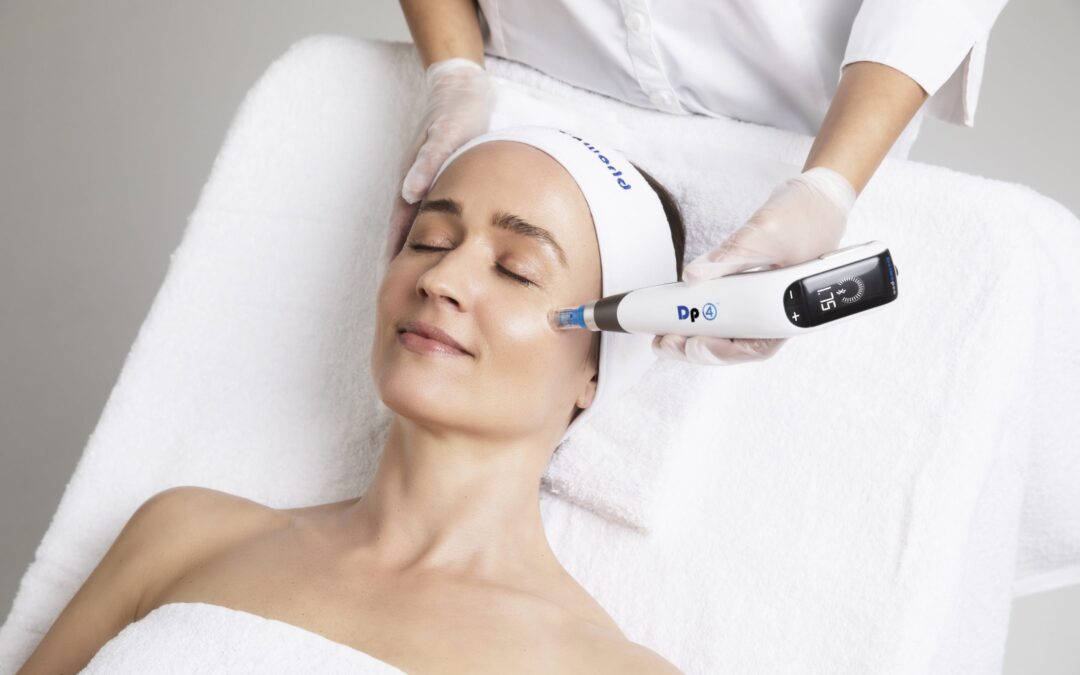
A radiofrequency skin treatment uses electrical energy, not light, to heat the deeper layers of the skin in a controlled way. At LuXe Concierge Aesthetics, it takes two forms: radiofrequency skin tightening, which heats the skin from the surface without breaking it, and RF microneedling, which carries the same energy into the skin on fine needles. This guide explains what each one is, what the official record says about the devices used here, and what a session, the recovery, and the risks look like.
Radiofrequency treatments at a glance
- What it is: an electrical current that heats tissue beneath the surface of the skin; the device is an electrosurgical device, not a laser.
- The two forms here: RF skin tightening, with a handpiece on intact skin, and RF microneedling, with fine needles that carry the energy into the skin.
- Devices used at the practice: Density, for skin tightening, and Pixel8, for RF microneedling.
- Areas treated here: the jawline, under the chin, the neck, and the cheeks for skin tightening; laxity, texture, scarring, and pores on the face for RF microneedling, as the practice describes them on its treatment pages.
- Session length as the practice describes it: about 30 to 45 minutes for skin tightening; about 45 minutes to an hour for RF microneedling, including numbing.
- When results appear: collagen takes time to form; for non invasive radiofrequency the American Academy of Dermatology puts the best results at about six months.
- Who performs it: Deborah Lenchus, MSN, APRN, personally, after evaluating your skin type, anatomy, and goals.
What a radiofrequency treatment is
A radiofrequency treatment delivers an alternating electrical current into the skin through a handpiece or a set of needles. Tissue resists the current, and that resistance produces heat where the energy is concentrated. Lasers and intense pulsed light work differently: they rely on a color target in the skin, such as pigment or blood, to absorb light. Radiofrequency has no light target, which is why the treatment pages here describe it as a different category from the resurfacing lasers.
Devices of this kind are regulated as electrosurgical devices. The two used at this practice each went through the 510(k) review process, and the record for each is linked in the Sources section at the foot of this page. What that record says, and what it does not say, is covered in its own section below.
Radiofrequency skin tightening, the non invasive form
Radiofrequency skin tightening heats the deeper skin through a handpiece placed on the surface, without needles. The American Academy of Dermatology describes it simply: the clinician places a device against the skin, which heats the tissue beneath. At LuXe the device is Density, and the practice uses it with monopolar and bipolar tips; a cooling system protects the surface while the deeper tissue is heated. The RF skin tightening page describes the treatment, the areas, and the visit in the practice’s own words.
Deborah plans this treatment for early to moderate laxity along the jawline, under the chin, on the neck, and across the cheeks, aimed at gradual firming rather than a surgical change. In her words on the treatment page: “I recommend it for patients who want gradual firming without surgery. It is not a facelift, and for significant sagging I will tell you honestly when another approach is warranted.”
What is RF microneedling?
RF microneedling is radiofrequency delivered through fine needles that enter the skin, so the heat is placed at a set depth rather than passed down from the surface. The needles make small channels, and the energy is released at their tips. Because needles enter the skin, this is a medical procedure with a short recovery, not a surface treatment. At LuXe the device is Pixel8, and the Pixel8 RF microneedling page covers the visit, the recovery, and the practice’s safety statement in full.
Deborah plans RF microneedling for patients who want firming and smoother texture together: early to moderate laxity, fine lines, acne scars and other textural scarring, enlarged pores, and crepey skin, as the treatment page lists them. Her own limit on it: “For deep wrinkles or heavy sun damage, a resurfacing laser does more.” A 2026 systematic review of twenty studies and 558 participants found that RF microneedling consistently improved skin texture and tightening on a standard improvement scale, with adverse events that were predominantly mild and transient.
What the official record says about each device
Density and Pixel8 are each FDA cleared for use in dermatologic and general surgical procedures for electrocoagulation and hemostasis, which in plain terms means using heat to coagulate tissue and control bleeding. That is the full wording of each clearance; neither names a treatment area, a skin concern, or a cosmetic result. Some radiofrequency devices carry an additional clearance for the non invasive treatment of wrinkles, and these two do not. The way the practice uses them for laxity and texture rests on the clinical literature and on Deborah’s judgment for each patient, which she discusses with you at the consultation.
Choosing between the two
The two treatments differ in where the heat goes and in what follows. Skin tightening keeps the surface intact and sends heat down from it; RF microneedling places the heat at depth through needles, which adds a short recovery and is how the practice approaches texture and scarring. The practice’s own comparison, RF skin tightening compared with RF microneedling, goes through the differences in detail, and a second article compares RF microneedling with standard microneedling.
Which one suits you is decided at the consultation, from your skin, the areas that concern you, and how much recovery time you can give it. Some patients are planned for one, some for both in sequence, and some are better served by a resurfacing laser or by a different treatment altogether; the consultation is where that is said plainly.
What a session is like
For skin tightening, the practice describes a session of about 30 to 45 minutes depending on the area: a gel is applied, the handpiece is moved over the skin, and most people feel warmth rather than pain. No numbing is needed, and the practice tells patients they can return to their day afterward.
For RF microneedling, the skin is cleansed and numbed first, because the needles go deeper than standard microneedling. The device is then applied across the treatment area, delivering the needles and the energy together; the practice describes the sensation as warmth and pressure, and the visit as about 45 minutes to an hour including numbing. The systematic review reported pain as typically mild to moderate and well tolerated.
Results, sessions, and how long they last
Results from radiofrequency build as collagen forms, which takes months rather than days. For non invasive radiofrequency, the American Academy of Dermatology says most people have one treatment and feel some tightening right away, that the best results appear in about six months, and that some people benefit from more than one treatment. The practice plans a short series of skin tightening sessions for most patients, with occasional maintenance as natural aging continues.
For RF microneedling, the practice plans a series of about three sessions spaced a month or so apart for most patients, followed by occasional maintenance. How long a result lasts depends on the skin you started with, how much laxity there was, and how you care for the skin afterward, so Deborah gives you a plan rather than a promise.
Risks, side effects, and when to call
Radiofrequency is energy delivered into living tissue, and the risks follow from that. For non invasive skin tightening, the American Academy of Dermatology lists usually some redness and swelling as the side effects to expect. The practice tells skin tightening patients to expect a little flushing that fades the same day, and RF microneedling patients to expect redness and warmth like a sunburn for one to three days, sometimes with mild swelling or tiny pinpoint marks.
RF microneedling carries more serious risks that you should know about before you decide. In October 2025 the FDA issued a safety communication on radiofrequency microneedling devices, reporting serious complications including burns, scarring, fat loss, disfigurement, and nerve damage, some requiring surgical repair. The communication states that RF microneedling is a medical procedure, not a cosmetic treatment, and advises patients to seek care from a licensed health care provider with training and experience on these devices, to ask which device will be used, and to seek care if they have any problems or concerns after the procedure. At LuXe, every RF microneedling treatment is performed personally by Deborah Lenchus, MSN, APRN, after evaluating your skin type, anatomy, and goals, and the practice reviews the benefits, alternatives, and possible side effects with you before beginning.
Call the practice the same day if a burn, a blister, unexpected or intense pain, or swelling that is getting worse appears after either treatment; the American Society for Laser Medicine and Surgery’s advice for every energy based treatment is not to wait and see whether it resolves on its own. Before either treatment, tell the practice if you are pregnant or breastfeeding, have a pacemaker, a defibrillator, or any other implanted electronic device, have metal implants in the area, have an active infection, breakout, or cold sore at the treatment site, or have a skin or healing condition; the practice reviews your health history before any session.
What radiofrequency treatments do not do
Neither treatment is a facelift. Radiofrequency does not remove excess skin or reposition tissue, and a patient with significant sagging is told so at the consultation. Neither treatment resurfaces the skin the way an ablative laser does; for deep wrinkles and heavy sun damage, the practice’s resurfacing lasers do more, and the fractional laser resurfacing hub explains those. Radiofrequency treatments are not a weight loss or fat reduction treatment, and nothing on this page should be read as a result you are promised; what a treatment can do for your skin is settled at the consultation, from your skin.
Questions patients ask
Is radiofrequency a laser?
No. A laser delivers light that a target in the skin absorbs; radiofrequency delivers an electrical current that heats tissue through its own resistance. The two are regulated and used differently, which is why the practice lists them as separate treatments.
Does radiofrequency skin tightening work?
The American Academy of Dermatology describes non invasive radiofrequency as a treatment for modest tightening, with most people feeling some tightening right away and the best results at about six months. It works best when there is a small amount of sagging; a large amount of loose skin is not what it is for, and Deborah will say so if that is what she sees.
What is RF microneedling good for?
The practice plans it for early to moderate laxity together with texture concerns: fine lines, acne scars and other scarring, enlarged pores, and crepey skin. In the 2026 systematic review, the consistent findings were improved skin texture and tightening.
Is RF microneedling safe?
It is a medical procedure with real risks, which is the position of the 2025 safety communication: burns, scarring, fat loss, disfigurement, and nerve damage have been reported with certain uses of these devices. In the published studies, side effects were predominantly mild and transient, most often redness and swelling. The agency’s advice is to have the treatment from a licensed provider trained on the device, and to ask which device will be used; here, that is Pixel8, used by Deborah Lenchus, MSN, APRN.
How many sessions will I need?
That is set at your consultation. The practice plans a short series for skin tightening and about three sessions a month or so apart for RF microneedling, with occasional maintenance after either.
Which one should I have?
If the surface of your skin is your main concern, texture, scarring, or pores, the needles of RF microneedling are what reach it. If early laxity along the jawline or neck is the concern and you want nothing that breaks the skin, skin tightening is the usual starting point. Deborah decides with you at the consultation, and sometimes the answer is a different treatment.
Book a consultation
A consultation with Deborah Lenchus, MSN, APRN comes first. She examines your skin, talks through what concerns you, and tells you which treatment, if any, she would plan for you. The consultation carries a fee, which is applied toward any treatment or product you choose.
Book online or call (754) 715-5667.
LuXe Concierge Aesthetics, 11336 West State Road 84, Ste 7 & 9, Davie, FL 33325.
Keep reading
- RF skin tightening in Davie, serving Weston, Fort Lauderdale, and Cooper City
- Pixel8 RF microneedling
- RF skin tightening compared with RF microneedling
- Microneedling compared with RF microneedling
- RF microneedling compared with the CO2 laser
- Fractional laser skin resurfacing
- IPL photofacial explained: intense pulsed light, and why it is not a laser
- Laser hair reduction explained: the diode wavelength and what it can and cannot do
Sources
- U.S. Food and Drug Administration. Potential Risks with Certain Uses of Radiofrequency (RF) Microneedling, FDA Safety Communication. Issued 10/15/2025.
- U.S. Food and Drug Administration. 510(k) Premarket Notification K250065, DENSITY, DENZA, DENSITY Noir (Jeisys Medical Incorporated). Decision letter 07/08/2025.
- U.S. Food and Drug Administration. 510(k) Premarket Notification K233147, PiXel8-RF (Rohrer Aesthetics). Decision letter 10/25/2023.
- U.S. Food and Drug Administration. 510(k) Premarket Notification K170758, Thermage FLX System (Solta Medical, Inc.). Decision letter 09/22/2017.
- American Academy of Dermatology. Many ways to firm sagging skin. Accessed 11/03/2026 (page undated).
- American Society for Laser Medicine and Surgery. Safety Tips for Patients Considering Cosmetic / Dermatologic Laser and Energy-Based Device Procedures. Approved by the ASLMS Board of Directors 04/13/2008; accessed 11/03/2026.
- Kumar N, Suh DH, Lee SJ, Kasif SA, Carruthers JDA. Radiofrequency Microneedling for Facial Rejuvenation: A Systematic Review. Journal of Cosmetic Dermatology. 2026;25(4):e70845. Published 04/2026.