
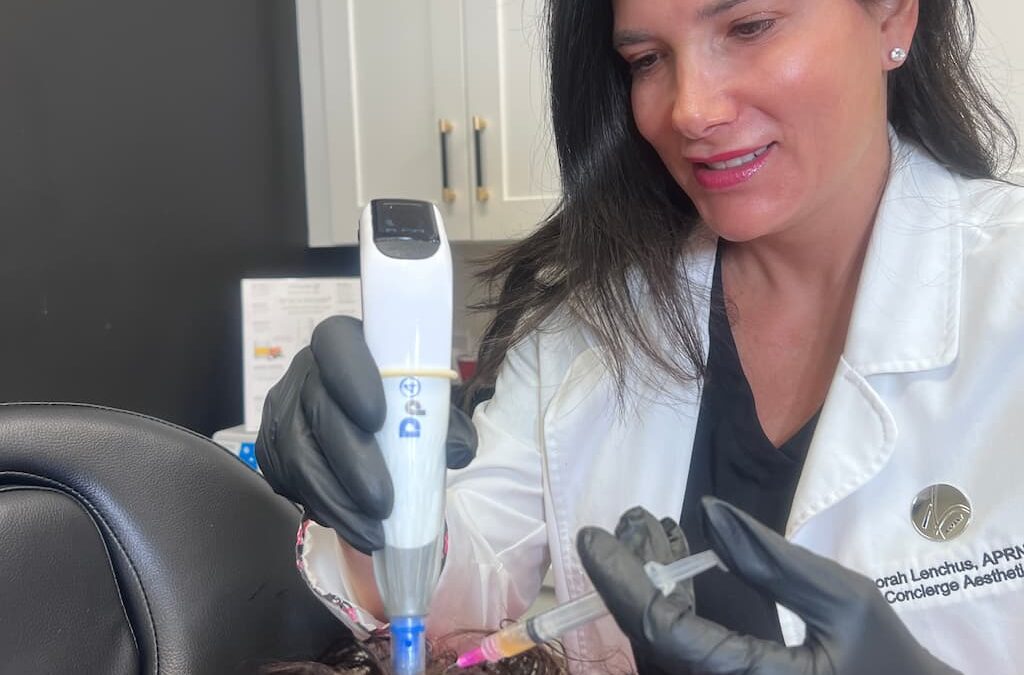
A medical spa, usually shortened to med spa, is a practice where licensed clinicians perform medical treatments for the face and skin in a setting that feels closer to a spa than to a doctor’s office. The treatments themselves are medicine: wrinkle relaxers and fillers are prescription products, resurfacing lasers are regulated medical devices, and a licensed provider is accountable for every one of them. A day spa offers massage, facials, and rest; it is not a medical practice, and nothing there requires a prescription.
A medical spa at a glance
- What it is: a practice offering medical treatments for the skin and face, with the atmosphere of a spa.
- What it treats: the appearance of lines, volume that thins with age, uneven texture and tone, brown spots and sun damage, redness, unwanted hair, and skin that has lost firmness.
- Who treats you: a licensed clinician. Which licenses may do what is set by each state.
- What is used: prescription injectables, regulated devices such as lasers and radiofrequency, and chemical peels.
- What it is not: a day spa, a dermatology practice, or a surgical practice. Each has its own work.
- How a visit starts: with a consultation, before anything is scheduled.
- At LuXe Concierge Aesthetics: a nurse practitioner owned and operated medical spa in Davie, Florida, where Deborah Lenchus, MSN, APRN performs every treatment.
What makes a spa a medical spa
A medical spa offers treatments that are, under the law, medicine. A wrinkle relaxer is a prescription drug. A dermal filler is a medical device, implanted beneath the skin. A resurfacing laser, a radiofrequency handpiece, and an intense pulsed light device are regulated medical devices. None of these can be bought at a counter or applied by someone without the authority to use them.
The U.S. Food and Drug Administration approves drugs and the highest risk class of devices, which includes fillers, and clears most lasers and energy devices. Approval and clearance are different words for different reviews, and each covers a specific use. FDA does not approve clinics, offices, or providers, so the phrase “FDA approved med spa” describes something that does not exist. The useful question is what each product is approved or cleared to do.
The spa part is the setting. The room is quiet, the appointment is unhurried, and no one is standing in the doorway. That matters for how a visit feels, and it changes nothing about what is being done to your skin. The medicine is the same medicine.
What a medical spa treats
A medical spa treats the appearance of the skin and the face. The concerns that bring most people in are familiar ones, and each maps to a category of treatment.
- Lines that form when you frown, raise your brows, or smile: wrinkle relaxers, the category most people ask for by the name Botox.
- Volume that thins with age in the cheeks, temples, lips, and jawline: dermal fillers and collagen biostimulators.
- Fine lines, uneven texture, and sun damage on the surface of the skin: laser skin resurfacing, chemical peels, and microneedling.
- Brown spots, redness, and small facial veins: IPL photofacial, a broad spectrum light treatment, and the vascular laser.
- Unwanted hair: laser hair reduction.
- Skin along the jaw and neck that has lost firmness: radiofrequency skin tightening.
A medical spa does not diagnose or treat skin disease. A spot that is changing, a rash that will not settle, or a mole you are unsure of belongs with a dermatologist first, and a medical spa is not a substitute for a skin exam.
Who performs the treatments at a medical spa
Licensed clinicians perform the treatments at a medical spa: physicians, nurse practitioners, physician assistants, and registered nurses, depending on the treatment and the state. Each state decides which license may inject, which may operate a laser, and what supervision has to be in place, and the rules differ from one state to the next. Florida sets its own rules on who may inject and who may operate a laser. Many medical spas also operate under a medical director, a physician who oversees the practice’s clinical standards; what that role requires is also set by the state.
Wherever you book, the fair question is a simple one: who holds the license, and who will be holding the syringe. At LuXe Concierge Aesthetics the answer is the same for every appointment. Deborah Lenchus, MSN, APRN, a nurse practitioner licensed in Florida, owns the practice and performs every treatment herself. Nothing is handed to a technician.
Medical spa vs day spa: the differences that matter
A medical spa and a day spa share a word and little else. The differences sit in why you go, who treats you, what is used, and what you can expect afterward.
- Purpose. A day spa is for rest: massage, facials, body treatments, and the feeling of having been cared for. A medical spa is for change you can see in the mirror: softer lines, restored volume, more even tone and texture.
- Who treats you. At a day spa, estheticians and massage therapists, skilled at what they do and working on the surface of the skin. At a medical spa, licensed clinicians.
- What is used. A day spa uses cosmetic products, which by law are for cleansing, beautifying, and altering the appearance. A medical spa uses prescription drugs and regulated devices, which are intended to change the structure of the skin beneath the surface.
- What the visit involves. At a day spa, you choose a treatment and receive it. At a medical spa, there is a consultation, a medical history, a conversation about what is realistic, and written consent before anything begins.
- What follows. From a day spa, you leave relaxed, and the effect is in how you feel. From a medical spa, you may leave with a few days of swelling, redness, or peeling, and the result builds over days to months.
- Risk. A facial can irritate the skin. An injectable or a laser treatment carries the risks that come with any medical procedure, which is why the person performing it is licensed and why the consultation comes first.
Both have their place. Many of our patients keep their day spa for the massage and come to us for the medicine.
How a medical spa compares with a dermatologist or a surgeon
A dermatologist is a physician who diagnoses and treats diseases of the skin, hair, and nails, and many dermatology practices also offer cosmetic treatments. A medical spa’s work is cosmetic. If you have a spot that is changing, persistent acne, a rash, or a mole you are unsure of, see a dermatologist first; once the skin is healthy, a medical spa can take care of its appearance.
A plastic surgeon operates. A facelift, a brow lift, or eyelid surgery moves tissue that no injectable or device can move. When the change you want is surgical, the honest answer is a surgeon, and a good medical spa will say so at the consultation.
What a first visit to a medical spa looks like
A first visit to a medical spa begins with a consultation, not a treatment. At LuXe Concierge Aesthetics you sit down with Deborah Lenchus to talk through your goals, your medical history, and the medications you take. She examines your face and skin, including 3D imaging that maps skin quality and facial volume, and you leave with a copy of what it shows. From there she builds a plan with you: what she recommends, in what order, and what she would not do. She will say no as readily as yes.
The consultation carries a fee, which is applied toward any treatment or product you choose. When you feel ready, many treatments can begin the same day or be scheduled for whenever suits you. Nothing is booked for you until you decide.
Questions worth asking any medical spa
A well run medical spa answers these without hesitation, and a reader who has them in hand can judge any practice, this one included.
- Who holds the license, and who will perform my treatment?
- Is there a consultation and a medical history before anything is scheduled?
- Which product or device will be used, and what is it approved or cleared to do?
- What happens if something goes wrong, and who do I call?
- May I see the practice’s own before and after photographs, taken in the same light and from the same angle?
Questions people ask about medical spas
What does med spa mean?
Med spa is the everyday shortening of medical spa. Medspa and medi spa mean the same thing. All of them describe a practice where licensed clinicians perform medical treatments for the skin and face in a spa like setting; the field itself is called medical aesthetics.
Is a medical spa a medical practice?
Yes. The treatments at a medical spa are medical treatments, performed by or under licensed clinicians, with a consultation, a medical history, and consent, as in any clinic. The spa is the setting; the medicine is the substance.
Is there such a thing as an FDA approved medical spa?
No. FDA approves drugs and certain devices for specific uses; it does not approve clinics, offices, or providers. A practice that says otherwise is describing something that does not exist. Ask instead what each product used on you is approved or cleared to do.
What is the difference between a medical spa and a day spa?
A medical spa performs medical treatments, such as injectables and laser treatments, under licensed clinicians. A day spa offers massage, facials, and body treatments that work on the surface of the skin and on how you feel. One is a medical practice in a calm setting; the other is a place to rest.
Should I see a medical spa or a dermatologist?
See a dermatologist for anything that could be a disease of the skin: a changing spot, a rash, persistent acne, hair loss you cannot explain. See a medical spa for the appearance of healthy skin: lines, volume, texture, tone, and unwanted hair. Many people use both.
Is LuXe Concierge Aesthetics a medical spa?
Yes. LuXe Concierge Aesthetics is a nurse practitioner owned and operated medical spa at 11336 West State Road 84, Ste 7 & 9, Davie, FL 33325, serving Weston, Cooper City, Fort Lauderdale, and the surrounding west Broward communities. Deborah Lenchus, MSN, APRN performs every treatment. The menu covers injectables, laser and energy treatments, skin and peels, and wellness services, and every visit begins with a consultation.
Book a consultation
The consultation comes first. Book online with Deborah Lenchus, or call or text (754) 715-5667.
Button: “Book a consultation” linking to https://luxeconciergeaesthetics.janeapp.com/
Keep reading
- Every treatment offered at LuXe Concierge Aesthetics
- About Deborah Lenchus, MSN, APRN
- Fractional laser skin resurfacing: what fractional means and the wavelengths used here
- Wrinkle relaxers at LuXe Concierge Aesthetics
- Medical spa serving Weston, FL
- What a nurse practitioner injector is
Sources
- American Society of Plastic Surgeons. Appropriate Business and Clinical Management of Medical Spas. https://www.plasticsurgery.org/documents/Health-Policy/Resources/2023-medical-spas-appropriate-management.pdf. Issued 12/15/2023.
- American Society for Dermatologic Surgery Association. Position on Physician Oversight in Medical Spas. https://www.asds.net/Portals/0/PDF/asdsa/asdsa-position-statement-physician-oversight-in-medical-spas.pdf. Updated January 2024.
- U.S. Food and Drug Administration. Is It Really “FDA Approved”? https://www.fda.gov/consumers/consumer-updates/it-really-fda-approved. Content current as of 05/04/2026.
- U.S. Food and Drug Administration. Is It a Cosmetic, a Drug, or Both? (Or Is It Soap?). https://www.fda.gov/cosmetics/cosmetics-laws-regulations/it-cosmetic-drug-or-both-or-it-soap. Content current as of 09/11/2024.
- U.S. Food and Drug Administration. Dermal Fillers (Soft Tissue Fillers). https://www.fda.gov/medical-devices/aesthetic-cosmetic-devices/dermal-fillers-soft-tissue-fillers. Content current as of 07/06/2023.