
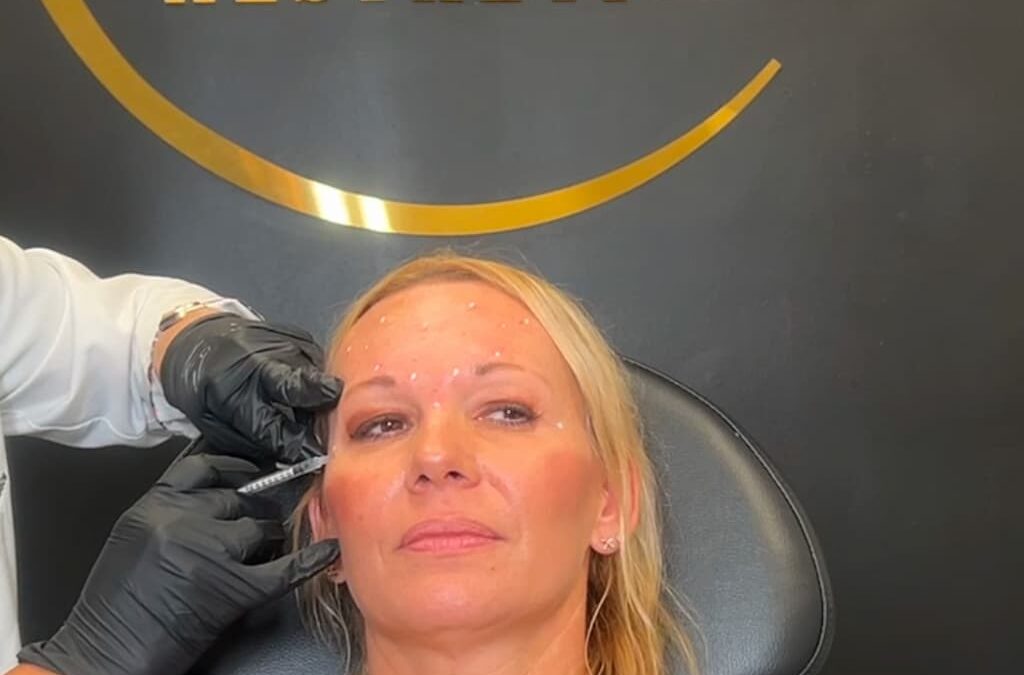
Botox is the brand name of one wrinkle relaxer: a purified protein, injected in small amounts into a facial muscle, so that the muscle contracts less and the line it folds into the skin softens. The class is called neuromodulators, because each product changes the signal between a nerve and a muscle rather than treating the skin itself. Five products in the class are used at LuXe Concierge Aesthetics in Davie, and all five work the same way; what differs is the formulation, the unit scale, and the lines each one has been studied for.
The essentials
- What it is. A purified botulinum toxin type A protein, made by a bacterium called Clostridium botulinum. It is a prescription drug, ordered and injected by a licensed provider; there is no pharmacy visit.
- What it does. Blocks the chemical signal that tells a muscle to contract, at the point where the nerve meets the muscle.
- What it treats. Lines that form when a muscle moves: frown lines between the brows, horizontal forehead lines, and crow’s feet.
- When it starts. Most people see a change within three to seven days.
- How long it lasts. About three to four months for frown lines in the studies behind the longest standing product; the effect fades gradually as the nerve signal returns.
- How often. Retreatment no sooner than three months.
- Who injects it here. Deborah Lenchus, MSN, APRN, personally, at every visit.
What is a neuromodulator?
A neuromodulator is a drug that changes how a nerve talks to a muscle. When you frown, a nerve releases a chemical messenger, acetylcholine, into the small gap where it meets the muscle, and the muscle contracts. A wrinkle relaxer binds to the nerve ending and stops that messenger from being released, so the treated muscle contracts less, and the skin above it stops being folded into the same crease over and over.
The effect is temporary. The product acts on the muscle it is placed in, which is why placement matters as much as the product chosen. Over the following months the nerve re-establishes its connection to the muscle, movement returns, and the line begins to show again. Nothing is cut, nothing is filled, and the skin itself is not changed; what changes is how often the muscle underneath it moves.
You will hear the class called neuromodulators, neurotoxins, wrinkle relaxers, or simply tox, and most people call every product in it Botox. At LuXe Concierge Aesthetics we use the plain term wrinkle relaxer for the category and the product name for the product.
Why Botox became the name for the whole category
Botox Cosmetic was the first product in the class to reach the market for frown lines, in 2002, and for most of the years since it was the only name people knew. The American Society of Plastic Surgeons notes that the cosmetic form of botulinum toxin is sometimes referred to as Botox by patients. The habit is harmless in conversation and confusing at a consultation, because the product in the syringe may be one of several.
The active ingredient in every product is botulinum toxin type A, purified from a bacterium and diluted to a dose measured in units. Botox Cosmetic, like most of the products in the class, is stabilized with human albumin, a protein derived from human blood; one of the newer products uses a peptide instead. These are formulation differences, and they are part of what your provider weighs when choosing a product for you.
The wrinkle relaxers used at LuXe
People searching for the types of Botox usually mean the products in the class, and five of them are used at LuXe Concierge Aesthetics. All five are FDA approved for the temporary improvement of moderate to severe frown lines in adults; for Botox Cosmetic the approval extends to crow’s feet, forehead lines, and the vertical bands of the neck, and for Xeomin to forehead lines and crow’s feet. Which one Deborah reaches for depends on your muscles, the areas being treated, and your history with the class, and the choice is made with you at the consultation.
- Botox Cosmetic (onabotulinumtoxinA). The longest history in the class. In its frown line studies the effect lasted about three to four months. Forehead lines are treated together with frown lines, because relaxing the forehead alone can let the brow drop.
- Dysport (abobotulinumtoxinA). Measured on its own unit scale, so a Dysport dose number does not compare with a Botox Cosmetic dose number. In its studies the effect lasted up to four months. Studied for frown lines in adults under 65.
- Xeomin (incobotulinumtoxinA). Studied for the upper face as one treatment: frown lines, forehead lines, and crow’s feet together. Across its uses the typical effect is described as up to 12 to 16 weeks, with onset within two to seven days.
- Jeuveau (prabotulinumtoxinA-xvfs). Studied for frown lines, with results measured at 30 days. No duration figure was established in those studies, so how long it lasts for you is a conversation about your own muscles rather than a published number.
- Daxxify (daxibotulinumtoxinA-lanm). Studied for frown lines, with results measured at four weeks. It is the product in the class formulated without human albumin, using a peptide instead. As with Jeuveau, its studies did not establish a duration figure.
A unit of one product is not a unit of another. Each product carries a statement that its units cannot be converted into the units of any other botulinum toxin product, which is why a unit count means nothing until you know which product it describes.
Other products in the class exist and more are in development; the five above are the ones on the shelf here. For a side by side look at onset and duration, read the practice’s comparison of the five wrinkle relaxers.
Which lines a wrinkle relaxer treats, and which it does not
A wrinkle relaxer treats dynamic lines, the ones that appear when a muscle moves and fade when the face is at rest. The three the class has been studied for are the vertical lines between the brows that people call the 11s, the horizontal lines across the forehead, and crow’s feet at the outer corners of the eyes. In each case the line is the skin folding over a muscle that is contracting, and the treatment works on the muscle.
Static lines, the ones still visible when the face is completely still, are a different matter. A line that has been folded into the skin for years may soften once the muscle beneath it rests, but it will not disappear, because the crease is now in the skin itself. Lost volume in the cheeks or temples, loose skin along the jaw, and lines caused by sun damage are not muscle problems, and a wrinkle relaxer does not address them. Those concerns call for a filler, a biostimulator, or a resurfacing treatment, sometimes alongside a wrinkle relaxer and sometimes instead of one. Deborah will tell you which, and she will say so if the answer is none of the above.
Other areas treated at LuXe
Beyond the three lines above, Deborah also places wrinkle relaxers in the lines that wrinkle across the nose when you smile, the muscles that lift the upper lip over the gums, the border of the upper lip, the lines around the mouth, the chin, the corners of the mouth, the brow, the masseter muscles at the angle of the jaw, the vertical bands of the neck, and the underarms. Each of these is planned at your consultation, with a dose and placement specific to the area, and each is described on the wrinkle relaxer treatment page.
What a wrinkle relaxer visit looks like
A wrinkle relaxer appointment at LuXe is unhurried and short. Here is the order of events.
- A consultation first. Deborah asks what bothers you, reviews your health history and any previous treatment with the class, and watches how your face moves at rest and in expression. The dose is set for your muscles.
- Marking and cleansing. The injection points are marked on the skin and the area is cleansed. Numbing is rarely needed; ice or a numbing cream is available if you prefer it.
- The injections. A series of small injections with a very fine needle, placed into the specific muscles behind the lines being treated. Most people describe a brief pinch. From the first injection to the last is usually a matter of minutes.
- Aftercare. Do not rub or massage the treated areas, and wait a couple of hours before strenuous exercise; both are standard advice from the dermatology societies, and both are on the written instructions you leave with. You can return to most everyday activities the same day.
- The follow up. Movement begins to soften within three to seven days for most people. Deborah will tell you when to look for the full effect and when she would like to see you again.
How long a wrinkle relaxer lasts, and why it fades
A wrinkle relaxer lasts for months, not years, because the nerve repairs the connection the product interrupted. In the frown line studies behind Botox Cosmetic the effect lasted about three to four months; for Dysport the figure is up to four months; Xeomin describes a typical effect of up to 12 to 16 weeks. Individual results vary with the muscle, the dose, and the person, which is why the practice talks about a range rather than a date.
Every product in the class is given no sooner than three months after the previous treatment, because dosing more often than that has not been studied for safety, and the practice does not schedule a top up inside that window. The practice’s article on how long a wrinkle relaxer lasts covers what shortens and lengthens the interval.
Side effects, risks, and who should not have a wrinkle relaxer
A wrinkle relaxer carries real risks, and the honest version is short. The common effects are at the injection site: a little pain, redness, a small bruise, and sometimes a headache in the days afterward. A drooping eyelid or brow happens in a small percentage of people; in the frown line studies behind Botox Cosmetic, 3 in 100 had a drooping eyelid, and in the forehead line studies 2 in 100 had a drooping brow. These effects appear within the first week and usually resolve on their own, though in some cases they last several months or longer.
The serious risks are the ones every product in the class carries a warning for. The FDA required Medication Guide states that the product may cause serious side effects that can be life threatening, including problems breathing or swallowing and spread of toxin effects, and that these symptoms can happen hours, days, to weeks after an injection. The risk is highest in people with certain nerve and muscle conditions, which is one reason the health history comes before the syringe.
Call the clinic or get medical help right away if you have any of these after treatment
- muscle weakness all over the body
- double vision, blurred vision, or drooping eyelids
- hoarseness or a change or loss of voice
- trouble saying words clearly
- loss of bladder control
- trouble breathing
- trouble swallowing
If you have weakness, vision problems, or dizziness after treatment, do not drive, operate machinery, or do other dangerous activities until they have cleared.
Who should not have a wrinkle relaxer
A wrinkle relaxer is not for you if you have had an allergic reaction to any botulinum toxin product, or if there is an infection at the place you would be injected. Dysport is also not used in anyone allergic to cow’s milk protein. Before treatment, tell Deborah about any disease that affects your muscles or nerves, any breathing or swallowing problems, any bleeding problems or blood thinning medicines, any surgery planned or past on your face, whether you are pregnant, planning a pregnancy, or breastfeeding, and whether you have had any botulinum toxin product in the last four months. None of these is a diagnosis made on this page; they are the questions a provider asks so the answer about treatment is the right one for you.
Questions people ask about wrinkle relaxers
Is Botox a neurotoxin?
Yes, by chemistry. Botox and every product in its class are made from botulinum toxin type A, a protein that blocks the signal from nerve to muscle; the class is called neurotoxins or neuromodulators for that reason. The cosmetic dose is small, purified, and placed into specific muscles. It is a prescription drug with a serious warning, and it is treated as one here.
What is the difference between Botox and Dysport?
Botox Cosmetic and Dysport are two products in the same class, made by different companies, with different unit scales and different formulations. Both are given for frown lines; Botox Cosmetic has also been studied for crow’s feet, forehead lines, and neck bands. Neither is the better product for everyone; the choice is made for your muscles at the consultation.
Will a wrinkle relaxer freeze my face?
Not when it is dosed and placed for your muscles. A frozen look comes from treating a muscle more than its job requires or from placing product where it was not needed. Deborah doses conservatively and places product based on how your face actually moves, so that the line softens and the expression stays. If you want more or less movement than that, say so; the dose is yours to set with her.
Do I need a wrinkle relaxer or a filler?
It depends on what is making the line. A line that appears when you move and fades at rest is a muscle line, and a wrinkle relaxer treats it. A hollow, a fold that is there at rest, or lost volume in the cheeks or lips is a volume problem, and a filler addresses it. Many people have some of each, and a consultation sorts out which is which before anything is injected.
How soon can I have a wrinkle relaxer again?
No sooner than three months after the previous treatment. The interval is written into every product in the class, because dosing more often than that has not been studied for safety. Most people return when movement comes back, which for frown lines is about three to four months after a Botox Cosmetic treatment.
Who injects wrinkle relaxers at LuXe Concierge Aesthetics?
Deborah Lenchus, MSN, APRN, a nurse practitioner licensed in Florida and the owner of the practice, performs every wrinkle relaxer treatment herself. Nothing is delegated to a technician or an assistant. You can read about her training and check her license on her provider page.
Book a consultation
If you are weighing a wrinkle relaxer for the first time, or you have had one elsewhere and want a second opinion on the product and the dose, start with a consultation. Deborah will look at how your face moves, tell you which lines a wrinkle relaxer will soften and which it will not, and set a plan with you. The consultation carries a fee, which is applied toward any treatment or product you choose.
Or call (754) 715-5667.
Keep reading
- Wrinkle relaxer treatment at LuXe in Davie, serving Weston, Fort Lauderdale, and Cooper City
- The five wrinkle relaxers compared: onset, duration, and who each suits
- How long a wrinkle relaxer lasts
- Is there a best age to start a wrinkle relaxer?
- Wrinkle relaxer myths and facts
- Deborah Lenchus, MSN, APRN
- What a medical spa is, and how it differs from a day spa
- What a nurse practitioner injector is
- Dermal fillers explained: hyaluronic acid gels
Sources
- U.S. Food and Drug Administration. Botox Cosmetic (onabotulinumtoxinA) Prescribing Information, BLA 103000. Revised 10/2024.
- U.S. Food and Drug Administration. Medication Guide, Botox and Botox Cosmetic (onabotulinumtoxinA). DailyMed. Revised 10/2024.
- U.S. Food and Drug Administration. Dysport (abobotulinumtoxinA) Prescribing Information, BLA 125274. Revised 09/2023.
- U.S. Food and Drug Administration. Xeomin (incobotulinumtoxinA) Prescribing Information, BLA 125360. Revised 02/2026.
- U.S. Food and Drug Administration. Jeuveau (prabotulinumtoxinA-xvfs) Prescribing Information, BLA 761085. Revised 07/2019.
- U.S. Food and Drug Administration. Daxxify (daxibotulinumtoxinA-lanm) Prescribing Information, BLA 761127. Revised 08/2023.
- American Academy of Dermatology. Botulinum toxin therapy: Overview, and Botulinum toxin therapy: FAQs. Accessed 10/26/2026 (pages undated).
- American Society for Dermatologic Surgery. Neuromodulators. Accessed 10/26/2026 (page undated).
- American Society of Plastic Surgeons. Botulinum Toxin. Accessed 10/26/2026 (page undated).