
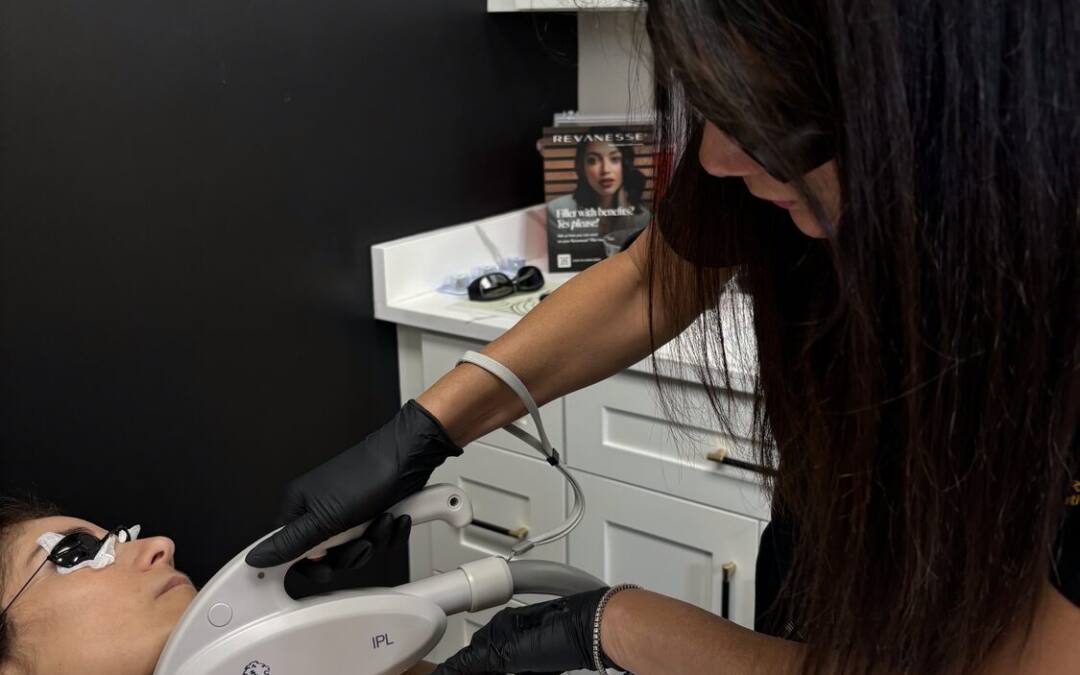
IPL treatment, short for intense pulsed light, is a light based skin treatment that clears brown spots and redness by sending filtered flashes of broad spectrum light into the skin, where pigment and small blood vessels absorb the light as heat and the body clears what was heated. An IPL photofacial is the everyday name for that treatment on the face, neck, and chest. IPL is often called a laser, and it is not one: a laser emits a single wavelength of light, while IPL emits a band of wavelengths that a filter narrows for the job.
IPL at a glance
- What it is: a light treatment, not a laser. A flashlamp produces broad-spectrum light, and a filter removes the shorter wavelengths before the light reaches the skin.
- What it targets: color. Brown pigment such as sun spots, freckles, and uneven tone, and red such as visible vessels, flushing, and the redness that comes with rosacea.
- What it does not treat: texture. Lines, pores, and scarring are laser work.
- Who it suits: lighter to medium skin tones that are not tanned. Darker skin tones and melasma are treated with other tools at LuXe.
- A session: about 20 to 30 minutes for the face, or up to 45 minutes with the neck and chest.
- The course: most people at LuXe need three to five sessions spaced three to four weeks apart, then occasional maintenance.
- Recovery: pink or red skin for a few hours; brown spots darken and flake over one to two weeks.
What IPL treatment is
IPL treatment uses a flashlamp rather than a laser source. The flashlamp emits a wide band of wavelengths, roughly 400 to 1,400 nanometers, and the handpiece holds a cutoff filter that blocks the wavelengths shorter than the number marked on it, so ultraviolet light never reaches the skin and only the useful part of the band does. Changing the filter changes what the light is aimed at. Intense pulsed light was first developed in 1992 to treat small leg vessels.
The treatment works because the skin contains structures that absorb light and convert it to heat. Melanin, the brown pigment in a sun spot or a freckle, absorbs one part of the band; hemoglobin, the red pigment in blood, absorbs another. A pulse of filtered light lands on the whole treated area, but only the targets that absorb it heat up, and the surrounding skin is spared. The body then clears the heated pigment and vessels over the following days and weeks. Clinicians call this selective photothermolysis, and it is the principle behind every light treatment of color in the skin.
At LuXe Concierge Aesthetics, the IPL handpiece carries interchangeable filters, four of them for skin, chosen for the concern being treated and for the patient’s skin tone: one for acne, one for distinct sun spots on fair skin, one for diffuse pigment and fine surface redness, and one for deeper redness. The IPL photofacial page describes each filter and the treatment areas in detail.
IPL vs laser: what is different, and why it matters
A laser and an IPL device differ in the light itself. A laser produces light of a single wavelength, with its waves running parallel and in step, which is what lets it be focused precisely on one target at one depth. IPL produces a broad band of wavelengths that are not in step, narrowed by a filter rather than generated at a single value. The FDA places the two in different product categories for this reason: IPL devices are classified as powered light based, non laser instruments, separate from laser surgical instruments.
The difference matters in the room. IPL is the better choice when color is spread across an area, such as sun damage over the cheeks or flushing across the nose and cheeks, because each pulse covers a wide patch of skin and the filter can be matched to brown or red. A laser is the better choice when the target is single and specific. At LuXe, one stubborn facial vessel or a cherry angioma goes to the 1064 nm vascular laser; brown spots on deeper skin tones go to the pico laser, which breaks up pigment with far less heat; and texture, meaning lines, pores, and scarring, goes to Erbium Glass 1540 nm resurfacing or to the fractional resurfacing lasers.
The name matters too. When a clinic calls IPL a laser, the candidacy and the expectations of a laser get attached to a device that behaves differently, and the patient arrives with the wrong picture of what will happen. BBL, a name some practices advertise, is a branded IPL device, so the same description applies to it. At LuXe, IPL is described as what it is: a light treatment, chosen for diffuse color and performed with settings selected for the skin in front of the provider.
What an IPL photofacial treats
IPL devices are FDA cleared for the treatment of benign pigmented lesions, such as freckles, sun spots, and uneven pigment, and benign vascular lesions, such as small facial vessels and the redness that comes with rosacea. That is the scope of the treatment: color in the skin, brown and red.
In South Florida, sun damage is the usual reason a patient asks about an IPL photofacial. At LuXe the treatment is used for sun damage and brown spots on the face, neck, chest, and hands; for facial redness and flushing and the small vessels that show through the skin; for the red and brown mottling that appears on the neck and chest after years of sun; and for certain kinds of acne, where a shorter wavelength filter targets the bacteria that drive breakouts. IPL devices can also be used for hair reduction, and that is not how IPL is used here; LuXe reserves a dedicated diode laser for hair, which is faster and more effective for that job.
One point of precision about redness. IPL treats the visible redness and the dilated vessels; it does not treat rosacea itself, which is a diagnosis a clinician makes. Persistent redness with bumps, burning, or eye symptoms is a reason for a medical evaluation first, and a series of IPL sessions may then be one part of managing it.
Who IPL suits, and who should choose something else
IPL does its best work on lighter to medium skin tones with sun damage, redness, or flushing. It is not used at LuXe on darker skin tones, on freshly tanned skin, or for melasma, because in those cases the light can worsen pigment or cause a burn. The reason is the physics above: melanin absorbs light, so the more melanin the skin carries, by nature or by a recent tan, the more of each pulse is absorbed by the skin itself instead of by the spot. For melasma the practice uses a pigment program rather than light, and for brown spots on deeper skin tones the pico laser is the tool.
Before any spot is treated, it is looked at. The American Academy of Dermatology advises a skin exam before treating age spots because what looks like an age spot can be skin cancer. A spot that is new, growing, or different from the others around it is a question for a skin exam, not for a light treatment, which is one reason the consultation comes first at LuXe.
A few circumstances call for waiting or for a different plan, and you will be asked about them at your consultation: a recent sunburn or tan; pregnancy or breastfeeding; a history of cold sores, since light treatments can trigger an outbreak and a short antiviral course before treatment may be advised; medications that increase light sensitivity; and recent treatments on the same skin. The practice asks you to avoid sun and sunless tanner for four weeks before a session, other laser treatments or peels for four weeks, injectables for two weeks, and strong actives for three days, and to tell your provider about every medication you take.
What an IPL session at LuXe is like
- The consultation comes first. Deborah Lenchus evaluates your skin, confirms that IPL is the right choice for your tone and your concern, and sets the plan. She performs every treatment herself.
- Eye protection goes on before the first pulse. Intense pulsed light can injure the eye, so shields are worn by the patient and the provider for the whole session.
- The filter, energy, and pulse settings are chosen for your skin type and for what is being treated. Cooling and comfort measures are used as needed; most people do not need numbing.
- Each pulse feels like the snap of a small rubber band. The face takes about 20 to 30 minutes; the face with the neck and chest takes up to 45 minutes.
- Afterward, the skin is pink or red and may sting a little, the way a mild sunburn does, for a few hours. Brown spots darken over two to three days, feel scaly like coffee grounds, and flake off within one to two weeks. The flaking is normal; the one rule is not to pick.
How many IPL sessions it takes, and how long results last
The effect of pulsed light is cumulative, which is why IPL is planned as a series. The published range is three to six treatments spaced two to four weeks apart for the full effect; at LuXe, most people need three to five sessions three to four weeks apart, followed by occasional maintenance. Heavier pigment and deeper vessels take more sessions than faint ones.
How long the result lasts depends on the skin and on the sun. A spot or a vessel that has been treated is gone, and new ones form with time and sun exposure, so age spots can return. Daily sun protection is what keeps a treated chest or pair of cheeks clear, which is why sunscreen is the first instruction after every IPL session. No fixed duration figure is published for IPL results, and this page does not invent one.
Risks, side effects, and when to call
The expected effects are mild and short. The treated skin is usually pink or red for four to eight hours or longer, with a stinging sensation like a mild sunburn that settles within four to six hours, and mild swelling that eases over several days. Most skin reactions after IPL settle within 2 to 48 hours. Brown spots darken and crust before they flake, and that darkening is part of the treatment working.
The risks that must be named are these: pain, swelling, discoloration (patches that heal lighter or darker than the surrounding skin, which can be lasting), bleeding, infection, scarring, and crusting. Blistering and burns can occur, and they are more likely at higher energy settings, on darker or tanned skin, and when the settings are wrong for the skin being treated, which is why reading the skin and choosing the settings are medical decisions at LuXe. Eye injury is possible if the eyes are not protected, which is why shields are worn. Light treatments can reactivate cold sores in people who get them. Fine dark hair growing near a treated area has been reported after IPL hair removal, most often on darker skin types; LuXe does not use IPL for hair.
Call the practice at (754) 715-5667 if you notice blistering or any sign of infection after a session, and call about anything that does not look or feel the way this page describes. Deborah Lenchus would rather see a concern early than hear about it later.
Aftercare after IPL
Sun protection is the non negotiable instruction, before and after. The practice asks you to stay out of direct sun and off self tanner for a couple of weeks, to apply a zinc based sunblock every day and reapply it every two hours outdoors, and to wear a hat and sunglasses. Beyond that, LuXe’s instructions are simple: cleanse gently, moisturize two to three times a day, let the dark spots flake off on their own, avoid retinol and acid actives for seven days, and avoid flushing activities such as exercise, spicy food, alcohol, and heat for two days. The American Society for Dermatologic Surgery adds one habit worth keeping: no makeup or lotion on the treated area for the first 24 hours or until the redness and stinging have gone.
IPL pairs well with treatments that address texture, provided they are staggered. At LuXe, that often means IPL followed by Erbium Glass resurfacing, with IPL clearing the color first and the laser refining texture and pores afterward, or IPL alongside chemical peels or RF microneedling, spaced safely so that tone and texture improve together.
Frequently asked questions about IPL treatment
Is IPL a laser?
No. IPL is a non laser light treatment. A laser emits one wavelength of light; IPL emits a broad band of wavelengths from a flashlamp and uses a filter to narrow it, and the FDA classifies IPL devices in a separate, non laser product category. Many patients and some clinics call IPL a laser out of habit; the two behave differently in the skin.
What is the difference between IPL and BBL?
BBL, or BroadBand Light, is one manufacturer’s branded IPL device. The physics and the category of treatment are the same. What changes the result is the person choosing the filter and the settings for your skin, not the brand on the handpiece.
Does an IPL photofacial hurt?
Each pulse feels like a small rubber band snapping against the skin, and most people find the session tolerable without numbing. Cooling and comfort measures are used as needed. Afterward the skin feels warm, like a mild sunburn, for a few hours.
Can IPL treat rosacea and facial redness?
IPL treats the visible redness, flushing, and small vessels that rosacea produces, and a series usually gives the most noticeable improvement. It does not treat rosacea itself, which is a diagnosis made by a clinician, and redness that comes with bumps, burning, or eye symptoms should be evaluated before any light treatment is planned.
Does IPL work on darker skin tones?
IPL is not used on darker skin tones or on tanned skin at LuXe, because the skin’s own melanin absorbs the light and the treatment can worsen pigment or cause a burn. For brown spots on deeper skin tones the practice uses the pico laser, which treats pigment with far less heat.
How much does an IPL photofacial cost?
The cost depends on the area treated, whether the face alone or the face with the neck, chest, or hands, and on whether you book a single session or a series. You receive a clear quote at your consultation; the consultation carries a fee, which is applied toward any treatment or product you choose.
Keep reading
- IPL photofacial at LuXe Concierge Aesthetics, serving Weston, Fort Lauderdale, and Cooper City: the treatment page, with the practice’s filters, areas, and full aftercare.
- Fractional laser skin resurfacing: the resurfacing lasers the practice uses for texture.
- Vascular laser for facial veins and cherry angiomas: the single wavelength tool for one stubborn vessel.
- Pico laser: pigment treatment for every skin tone, including the tones IPL does not suit.
- Sun damage treatment, brown spots and pigmentation, and rosacea and facial redness: the concern pages.
- Melasma and pigmentation: the pigment program used in place of light for melasma.
Sources
- U.S. Food and Drug Administration. Product Classification: Powered Light Based Non-Laser Surgical Instrument With Thermal Effect (product code ONF). Page last updated 09/28/2026.
- U.S. Food and Drug Administration. Product Classification: Powered Laser Surgical Instrument (product code GEX). Page last updated 11/02/2026.
- U.S. Food and Drug Administration. 510(k) Summary K251632, Optimas MAX System with Lumecca Peak Applicators (InMode Ltd.). Decision date 06/26/2025.
- American Society for Dermatologic Surgery. Intense Pulsed Light Therapy for Aging Skin. Accessed 11/03/2026 (page undated).
- American Society for Dermatologic Surgery. Laser/Light Therapy. Accessed 11/03/2026 (page undated).
- American Society for Laser Medicine and Surgery. Vascular and Pigmented Lesions. Accessed 11/03/2026 (page undated).
- American Academy of Dermatology. How to fade dark spots / age spots. Last updated 09/28/2021.
- Gade A, Vasile GF, Hohman MH, Rubenstein R. Intense Pulsed Light (IPL) Therapy. StatPearls, NCBI Bookshelf. Last update 03/01/2024.